Sunday, March 23, 2014

Red-headed Woodpeckers were a Highlight on our Friday Outing


We drove west from Port Rowan through Port Royal Friday afternoon all the way down to Norfolk County Road 28. 


At that point we went north to the  Jackson Gunn Forest to see if we could relocate the Red Headed Woodpeckers we'd seen last Sunday March 16th.  


We did, without a lot of effort.  I think at least four of them are present in these woods. (Here is one of Graham's photos from Friday.) We headed back seeing hundreds of Tundra Swans and a dozen or so Sandhill Cranes along Lakeshore Road and the Causeway.
The presence of these woodpeckers is interesting as this bird is listed as threatened in Canada and of special concern in Ontario.


There is a good piece by Barbara Frei in the latest Ontario Nature (http://www.vdocshop.com/doc/on-nature-magazine/spring2014/2014031201/#22) that talks about some of the reasons this woodpecker, which was once quite common, is now not doing so well.


Ms. Frei cites a population decline in Ontario of more than 60 percent in a twenty year period from the 1980's.


Today (Sunday) we looked at large numbers of Tundra Swans from the Causeway.  The Ontario Field Ornithologists who had a field trip here on Saturday put their numbers at about 4,000.


Sunday, February 23, 2014

Family Day 2014

We went looking for a reported Yellow Headed Blackbird on Family Day on the First Concession near Port Rowan.

We didn’t find it or any blackbirds for that matter.

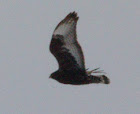
We did get a fairly good but brief look at a Rough Legged Hawk Dark Morph on the First Concession at Dedrick Road. 


Rough Legged Hawk Dark Morph
in Port Rowan on Family Day
This is a northern hawk that breeds in the Artic and comes down here in the fall.(http://www.allaboutbirds.org/guide/Rough-legged_Hawk/id)

Apparently, 25-40% of Rough Legged Hawks found in eastern North America are dark morphs.


On that Family Day, we also saw Snow Buntings in various locations between here and St. Williams but Graham got the best shots at a feeder close to home on Front Road.


Saturday, December 28, 2013

Friday, December 27, 2013

Found at (the Former) Sewage Lagoons

Graham found an Eastern Meadowlark at (the former) Port Rowan Sewage Lagoons late this afternoon.

When he went back with a camera he got this shot.

Great Horned Owl - December 27th Port Rowan

Saturday, December 14, 2013

Christmas Bird Counting on A Wintry Day in Port Rowan


Diamond the Dog and I wandered over to Bird Studies Canada (BSC) earlier today.
 
You could hear, but not really see,  the Tundra Swans, in the Inner Bay which is ice covered as far as you can see through the snow. 

It is pretty much blizzard conditions here. 

As I write, the BSC weatherboard says it is minus 7.9 with a wind chill making it feel like minus 15.9.  Winds of about 25 kilometres per hour mean I’m going to do my birding from indoors today.

That is not the case for the hearty Christmas counters.  Two of them departed from our home around sunrise this morning.  Early reports include sightings of an Eastern Towhee and a Catbird.
 
Some of you will undoubtedly know the history of the Christmas Counts.

Not that long ago the Christmas holiday season was an occasion to haul out your gun and go out and shoot as many birds as you could find.

In 1900 ornithologist Frank Chapman came up with an option to killing birds that, if not sport, at least seems more sporting. 

Toward the end of the 19th century the conservation movement was starting to grow and Chapman developed the idea of a bird census for Christmas Day that year.   That first Christmas event was held in 25 different locations around North America.  Apparently there were 27 counters covering these 25 locations suggesting an extremely solitary pursuit for most participating counters.  A total of 89 species and about 18,500 individuals were recorded when all the counts were combined.

The list from 1900 includes at least two species that aren’t in good shape 113 years later.  The Greater Prairie Chicken, for one,   was once abundant in Ontario is almost gone due to habitat destruction.  Another bird, the White Headed Woodpecker is on the threatened list in Canada with only a few birds breeding in the South Okanagan.  Unlike woodpeckers that we are familiar with it likes seeds (not insects) and prefers ponderosa pines for its habitat.

Two of these first counts were in Canadian locations – Toronto and Scotch Lake, York County, New Brunswick (near Fredericton.)  At Scotch Lake William H. Moore spent an hour on Christmas morning and recorded 36 birds representing nine species. (See The Christmas Bird Count:  A Long Tradition by David Christie at http://www.elements.nb.ca/theme/winter/david/david.htm)

Find out more about the Christmas counts at http://www.bsc-eoc.org/organization/bscnews.html

Sightings from the last Couple of Weeks

Here are some birds family members have seen over the last couple of weeks.  Maybe the counters will find them today.

We've had some different sightings lately.

Some you could expect.  Others maybe not.

In the expected category there are, of course, lots of Tundra Swans and Sandhill Cranes around these days.  Usually we are seeing them in large numbers west of Highway #59 along the Lakeshore toward and beyond Lee Browns.

Graham got a shot of this American Pipit on November 30th on our way to look for Yellow Headed Blackbirds.


We didn't find those blackbirds on that occasion but later on December 7th Graham and Ross photographed one on the First Concession. The picture was good enough for ID purposes but not to include here.


Around the same time three Snowy Owls were observed.  Here is one in flight.


The same day we had the Pipit we had this guy.  A Pigeon (I believe called a Roller)
                   
on our back porch could be called unexpected.


Sunday, November 24, 2013

Algonquin Park in November

We haven’t been too diligent documenting birds around town lately.

We were, however, up at Algonquin this past week and managed to see a few birds.
Son Ross leads us to a number of regular stops in what has become a regular mid-November routine for him.

At the west park gate a few minutes after having caught a glimpse of a skittish moose we observed eight evening grosbeaks at quite a distance. We struggled to capture them on camera. 

The Gray Jays weren’t terribly interested in us at the Spruce Bog Trail.  Yes, I thought it was our warm personalities and chipped sunflower seed.  But the only two seen were busy on a large suet feeder and barely looked at us as we passed.


Opeongo Lake Visit November 2012
Purple finches were seen at the Visitor Centre, Ross got a couple of Black Backed Woodpeckers on the Opeongo Lake Road and two common loons were about all that could be found at the Outfitting Station. 

The south end of the lake was nearly all
frozen over unlike our visit in 2012.


The Gray Jays off the Mizzy Lake Road behaved in more characteristic Gray Jay style as we hiked along the old railroad bed.

As the sun was about to set we caught sight of a Ruffed Grouse flying in front of our car on the Mizzy Lake Road.

Algonquin Park postings can be found weekly at http://www.algonquinpark.on.ca/news/algonquin_park_birding_report.php
 

Friday, November 8, 2013

Cattle Egret


We finally got out of the house to see the Cattle Egret.

It was located, without much effort, with the cows at 8th Concession and Hazen just before sundown.  That is north and west of the village of Walsingham, which is on Highway #59.

According to the Cornell Lab of Ornithology (http://www.allaboutbirds.org/guide/cattle_egret/id), the Cattle Egret is originally from Africa and found its way to North America in 1953 and quickly spread across the continent.

You’ll find it in fields, not streams, where it eats insects and small animals.
Most spend their winters in the southern United States where the temperature rarely falls below 5 degrees Celsius. Some find their way to more northern coastal areas where winters are mild. Their North American range is still expanding.

On the way home, we headed west along Lakeshore where we picked up fifty or so Sandhill Cranes on the north side before Port Royal, another 30 on the south side just west of Port Royal.   One individual was grazing at Lee  Browns.

Tundra Swans are moving around town and Northern Saw-whet Owl Banding continues at the Long Point  Bird Observatory Old Cut Banding. Station. (See www.birdscanada.org/lpbo)
    
Banding closes for the season on November 15th

Northern Saw-whet being banded October 30th at Old Cut.


BIRDS IN PORT ROWAN/LONG POINT

As usual migration time is always busy at Long Point/Port Rowan. The spring of 2023 was the 64 th consecutive year that bird migration wa...